Canada’s Energy Minister Is Hearing From Energy CEOs On Trump Tariffs. Here’s His View On The Issue.
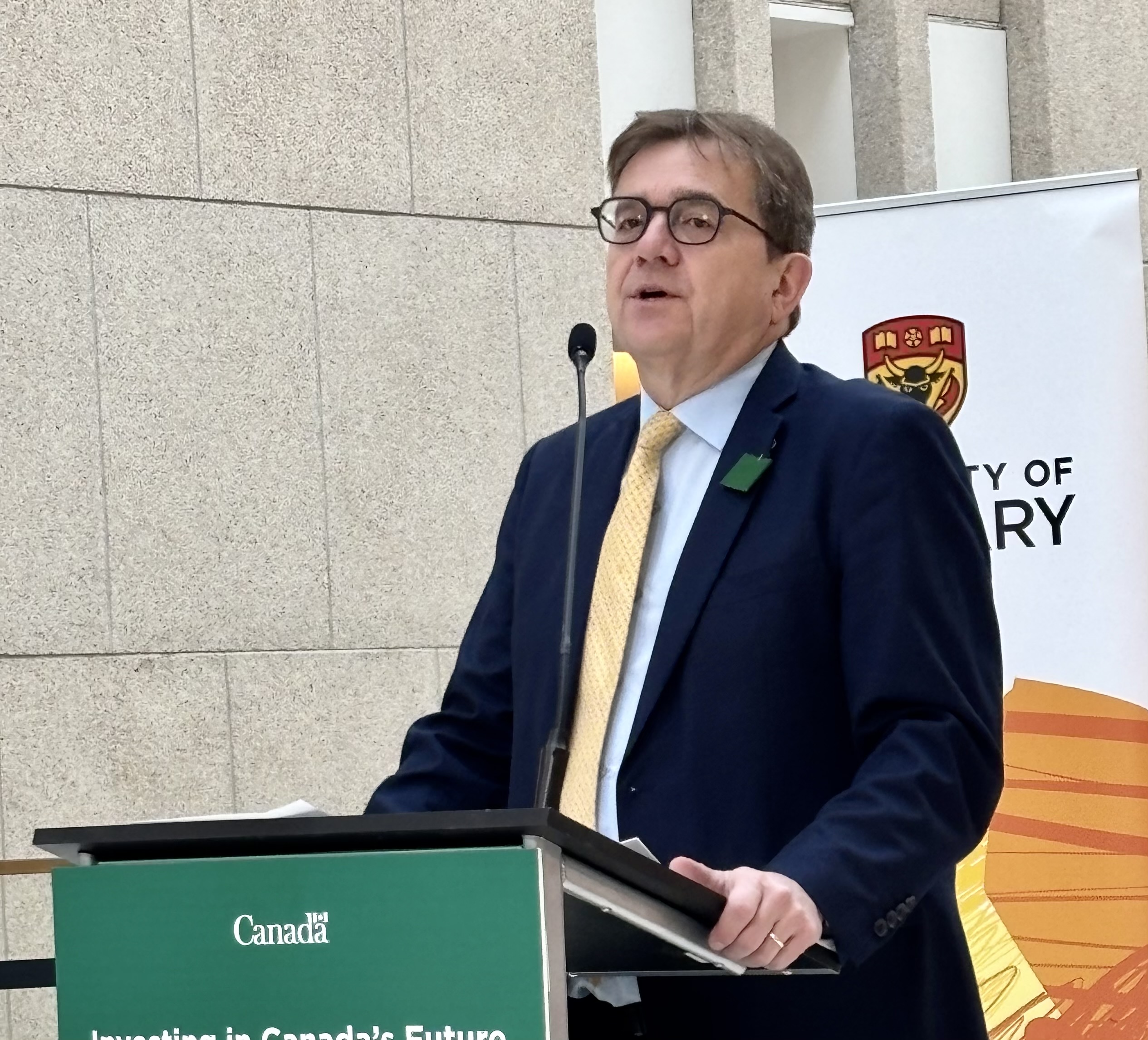
Energy executives have shared their views with Ottawa on navigating the U.S. tariff threat and are working with their customers to lobby the Trump government, says a federal minister.
During a funding announcement at the University of Calgary on Wednesday, Canada’s Energy and Natural Resources Minister Jonathan Wilkinson was asked by a reporter if energy and natural resource companies are ready if tariffs from new U.S. President Donald Trump are put in place.
At the time this was written, Feb. 1 was the most recent date discussed by Trump on potential implementation of tariffs, which would include all Canadian goods.
“I’m not entirely sure how you get ready,” he replied. “They will be facing the situation where their products are all going to get marked up by 25 per cent, if that is what happens. And they will be looking to ensure that tariff is paid by the customers in the United States rather than them.
“That’s obviously going to be in some cases a bit of a negotiation. If you were an American refinery, you’d probably be pushing back and trying to have some of that tariff absorbed upstream in Canada.”
Wilkinson said he thinks these companies have been developing strategies on how they would manage that. He also noted that they have been doing “their own lobbying” in Washington, D.C. That includes working with their customers to have these customers speak directly to the Trump administration.
“We certainly have been talking to them — I have probably spoken to most of the CEOs in energy and resource companies in this country over the past few weeks,” said the minister.
“I had a large roundtable in Saskatoon yesterday, I have one right after this. We are trying to ensure that we are co-ordinated, and we are hearing from them in terms of what they’d be liking us to do, and we are also encouraging them to weigh in themselves.”
Wilkinson did not specify what the recommendations from these companies were.
What about oil and gas exports?
During his prepared remarks, he said any response from the Canadian government to U.S. tariffs needs to be done in a thoughtful way, describing it as “regionally-fair, regionally-equitable” and not targeting any specific sector of the country.
To that end, Wilkinson was asked if cutting off energy exports to the U.S. then ceases to be an option.
According to the minister, removing potential points of leverage is not the right move.
“I would say, the government of Canada is of the view that Mr. Trump is a very skilled negotiator — taking tools off the table before we have even entered the negotiation is just not wise,” he said.
“I am not saying that we are not going to look at doing that at all ever, but I would say in the context of thinking about how best to respond, it has to be done in a manner that is thoughtful, that actually doesn’t harm Canada’s long-term interests, and as I say, that is regionally fair.”
Wilkinson went on to say, as an MP from British Columbia and someone who grew up in Saskatchewan, he knows the west can’t be singled out.
“It has to be something that is going to be fair, and if there is pain, Quebec will feel it, Ontario will feel it, the west will feel it, Atlantic Canada will feel it.”
When asked how fairness can be achieved when regions have disparate export volumes to the U.S., Wilkinson noted the need to factor in exposure percentage.
In that regard, he said he thinks Alberta and Ontario are, in fact, not the “most exposed” provinces on the U.S. trade front, citing New Brunswick as first in that category.
“You’re never going to have a perfect every-province-has-exactly-the-same impact,” Wilkinson continued.
“But you do have to think about trying to ensure that you are not asking any particular region of the country to do significantly more than others.”
Despite efforts from the federal and provincial governments, communicating to the U.S federal government that tariffs would be harmful to Americans, there has been no indication that Trump has changed his mind.
Wilkinson said it’s going to be a bumpy ride and determining what Trump wants is not simple.
The word out of Washington
“When I was in Washington a couple of weeks ago, I met with many senior Republican folks including people like [Texas] Senator Ted Cruz, who has been around for a little while,” said Wilkinson, noting that Cruz knows Trump well.
“When you talk to all of those folks, the general answer you get is ‘we don’t really understand why’ they’re targeting Canada, ‘it doesn’t really seem to make any economic sense,’” he added. “And when you ask them, ‘what do you think he’s going to do?’ They all say: ‘we have no idea.’”
According to Wilkinson, Trump talks to a lot of people but it’s not entirely clear which of them are influential to him.
“Part of any … thoughtful strategy is to talk to a lot of people, such that he is hearing a similar message from a whole range of folks,” continued the minister. “That’s not just people in his administration, that’s certainly people in congress, but it’s also American business.”
He mentioned meeting with the American Petroleum Institute (API), and a “whole range of American businesses.
“Because at the end of the day, it is American business talking to Americans that are going to be more persuasive than Canadians trying to tell Americans that we know what is in their best interest.”
Wilkinson said in his areas, it is fortunate that Doug Burgum and Chris Wright are going to be confirmed in the coming days. Wright is Trump’s pick for energy secretary and Burgum is his selection for secretary of the interior.
“Both of those folks know Canada well,” said Wilkinson. “Burgum, having been the governor of North Dakota, would understand the negative impacts of tariffs.”