TMX Crude’s Market Share In Asia-Pacific On The Rise
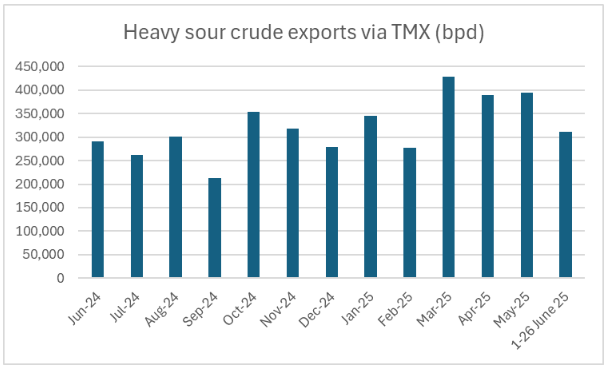
Heavy sour Canadian crude is capturing a growing share of the market for heavy crude arriving in Asia-Pacific this year. The Canadian exports are benefiting from the diminishing availability of heavy cargoes from sources such as Saudi Arabia and Venezuela, and the falling demand from U.S. West Coast refiners has been pushing more TMX barrels to Asia.
The share of Canadian crude exported to Asia-Pacific from the 540,000-bbl/d Trans Mountain Expansion (TMX) pipeline has grown significantly this year compared to the second half of 2024. Nearly three-quarters of TMX cargoes were shipped to Asia-Pacific in the first half of 2025, oil analytics firm Vortexa shows. In May 2025, a record 82 per cent of the 394,000 bbls/d of heavy Canadian waterborne exports went to Asia-Pacific. By comparison, in the second half of 2024, Asia-Pacific buyers took only around 50 per cent of TMX cargoes, while the remaining 50 per cent of June-December 2024 cargoes went to the U.S. West Coast.
Among Asia-Pacific buyers of Canadian crude, China is the biggest. It accounts for around two-thirds of all Vancouver crude exports to Asia-Pacific. Loadings of heavy Canadian crude to China have averaged over 243,000 bbls/d this year, up by nearly 80,000 bbls/d on the second half of 2024. South Korea has also become a regular destination, with two Korea-bound TMX cargoes leaving Vancouver in May. Singapore recently took its first two cargoes, and Indian refiners have been heard looking seriously at taking TMX grades from Vancouver. Typically, India has bought heavy Canadian crude from the U.S. Gulf Coast, where the crude can be loaded onto two-million-bbl VLCCs. Vancouver is limited to using smaller — and normally more expensive — Aframax tankers. But the freight economics have shifted in Vancouver’s favour this year.
Credit: Vortexa
Asian interest in heavy crude loading from Vancouver has increased as buyers seek substitutes for heavy sour Venezuelan Merey and Arab Heavy from Saudi Arabia. Saudi Arabia’s state-controlled Saudi Aramco may be using higher volumes of heavier crudes domestically for power generation. Shipments of Arab Heavy to Asia-Pacific have dropped sharply this year to under 500,000 bbls/d, down from over 800,000 bbls/d last year, according to Vortexa. Power generation demand in Saudi Arabia increases during the summer months, which may further cap exports in the next few months.
Credit: Vortexa
Flows of sanctioned Venezuelan Merey to China also have begun to ebb since February, when the administration of U.S. President Donald Trump revoked the sanctions waiver that had allowed Chevron Corporation to operate in Venezuela. Chevron gradually wound-down its activity in Venezuela through May 27. State-owned PdV has been taking over Chevron’s upstream activity in Venezuela, but its efforts have not been able to stop a fall in exports. Venezuela’s crude shipments to China fell from 343,000 bbls/d in January-February to 284,000 bbls/d in May, apparently prompting some Chinese refiners to replace those barrels with similar quality TMX grades.
Share growth
The forecast decline of U.S. West Coast refining capacity also is likely to support Canada’s growing market share in Asia-Pacific’s heavy crude import market. U.S. independent refiner Valero Energy Corporation is planning to shut or repurpose its 145,000-bbl/d refinery in Benicia, Calif., by April 2026, while Phillips 66 is planning to shut its 139,000-bbl/d Los Angeles refinery by October. Valero is also evaluating strategic alternatives for its 85,000-bbl/d Wilmington refinery in Los Angeles. Combined, the three refineries make up 17 per cent of Californian refining capacity.
Multiple Canadian producers are understood to be looking to charter Aframaxes, allowing them to sell TMX crude on a delivered basis in Asia-Pacific. That move could allow the Canadian crude producers to keep the price of Cold Lake and AWB competitive in the Asia-Pacific market, while also keeping a bit more of the margin between Western Canada and Asia to themselves. Increased tolls that took effect on the TMX pipeline from May 1 have created some upward pressure on fob Vancouver prices, possibly discouraging Asian buyers and keeping sales volume lower than the peaks seen in March and April. Strong demand from the U.S. Gulf Coast has tended to push up prices at Edmonton.
Chinese buying of heavy Canadian TMX crude appears broadly unaffected by the recent crisis in the Mideast Gulf. Crude from Vancouver trades roughly a month ahead of Mideast Gulf cargoes, meaning any prompt effects from the Iran-Israel conflict would be unlikely to have impacted trade yet. Heavy Canadian crude is currently trading for September/October-arrival in China, while trade for September-arrival Saudi and Iraqi crude will not begin in earnest until the release of the August official formula prices.