TMX Crude Sellers Taking To The Water
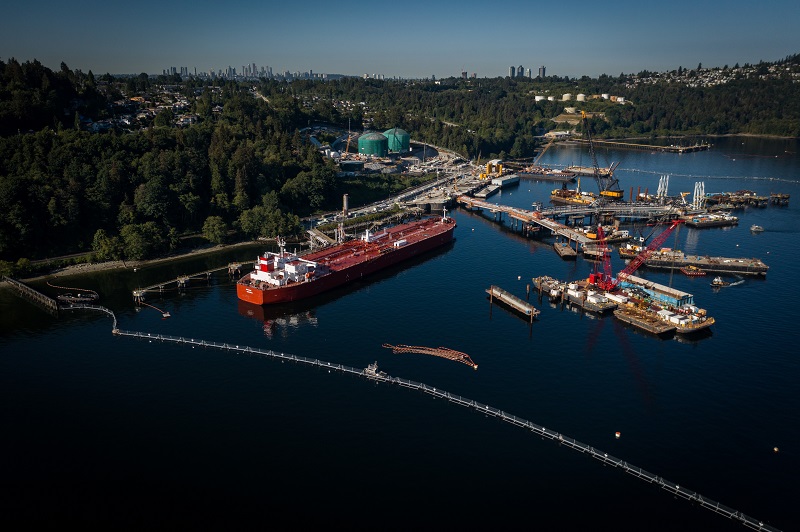
New higher interim tolls on the Trans Mountain Expansion (TMX) pipeline and lower costs for Aframax fixtures at Vancouver are prompting Canadian crude producers to seek term shipping fixtures and to sell crude on a delivered basis.
Sellers of crude through Trans Mountain’s 890,000-bbl/d pipeline could see two key benefits from committing to term Aframax fixtures out of Vancouver’s Westridge docks. First, a company with term shipping can pass on to Asian or U.S. west coast buyers the 20¢/bbl rise in committed shipper tolls on TMX that took effect on May 1. Companies selling fob at Vancouver would likely have to absorb the rise in TMX tolls to stay competitive at Vancouver.
Second, a company looking now to lock in a shipping contract could hope to capture the recent decline in freight rates for Aframaxes moving to Asia. The Vancouver-China Aframax rate has fallen to a year-to-date low of $1.9 million, or $3.51/bbl for Cold Lake, as of May 14. Two companies have been heard locking in term shipping at that rate. The Vancouver-U.S. west coast Aframax rate fell by WS15 to WS140, the lowest since Feb. 5.
Premium pipeline
Under the new May 1 TMX tolls, the total cost for committed shippers to transport heavy crude from Edmonton, Alta., to the Westridge Marine Terminal now ranges from approximately $9.11/bbl to $7.71/bbl, up from $8.87/bbl to $7.49/bbl, according to Trans Mountain’s latest toll schedule. Pipeline tariffs will vary based on both the length and volume of shippers’ commitments, with fixed costs lower for shippers willing to make longer and larger commitments on the pipeline.
Increases in fixed tolls for committed shippers ranged from 22¢/bbl to 24¢/bbl, while the variable toll charged to all crude shippers rose by 4¢/bbl across the board. Fixed costs to ship light or heavy crude are usually the same, but variable tolls to ship light barrels are 5¢/bbl cheaper than heavy barrels. Shippers are also able to receive a 9¢/bbl direct injection credit if barrels are directly injected into the pipeline without using Trans Mountain’s tanks. This has remained unchanged from the previous toll schedule.
Tariffs for heavy uncommitted shippers rose by 27¢/bbl to $9.96/bbl. Variable costs for uncommitted and committed shippers are the same. Uncommitted spot capacity on the pipeline has yet to be utilized since the pipeline’s expansion in May 2024, with the pipeline remaining unapportioned during this period.
Increases in pipeline tolls have made the heavy arbitrage to Vancouver more difficult for committed shippers to work, especially given second quarter oilsands maintenance, tighter fundamentals and a subsequent firmer Canadian crude differential. An approximate $8/bbl locational spread between heavy barrels at Edmonton and Westridge hints that the arbitrage may be barely open for shippers with a 20-year and 75,000-bbl/d commitment on the line, while other committed shippers may only be able to break even or suffer slight losses if they were to sell barrels fob at Westridge. The arb remains well closed for uncommitted shippers given the higher tolls they are charged.
Trade for July-loading fob crude at Westridge has remained muted relative to prior months, with more shippers heard chartering their own tankers to capture the full value of their barrels by selling on a delivered basis rather than at Westridge. The move is supported by lower Aframax rates, which have also led to a preference for direct-to-Asia shipments of Canadian crude over transfers to VLCC for the move to Asia.
Rising VLCC rates have made the direct Aframax route more economical by comparison. The combined effect of the shifts in shipping rates has been fewer Aframaxes moving to the U.S. west coast to transfer cargoes onto VLCCs.
As for the TMX pipeline costs, final tolls are not scheduled to be decided until January next year, said the Canada Energy Regulator. At issue is who will bear the brunt of the project’s construction cost overruns — the shippers who made commitments more than a decade ago, or Trans Mountain. Shippers contend they should not be responsible for billions of dollars in extra project costs, which would be baked into tolls paid for the duration of their lengthy contracts. The federal government bought the existing 300,000-bbl/d Trans Mountain system and TMX for C$4.5 billion in 2018 and has maintained a plan to sell the system. Prospective buyers are expected to stay on the sidelines until the tolling situation has been resolved.
A recent edition of Argus’s “The Crude Report” podcast provides more details on TMX sellers taking to the water. Click here to access.