Low Carbon Solutions The Bitumen Beyond Combustion Series, Part 2 – Asphalt Binder
In Part 1 of this multi-part series, Alberta Innovates identified asphalt binder — the glue that holds the asphalt mix together — as the bitumen beyond combustion (BBC) product having “the greatest potential of achieving commercial success” in the short and longer term.
The reasons for this according to Paolo Bomben, director of Bitumen Beyond Combustion at Alberta Innovates, despite asphalt binder selling for a lower price than carbon fibre or energy carbon materials, are threefold.
“There are no obvious technological barriers to expanding asphalt binder production,” he said. “Producing asphalt binder from bitumen [and other heavy oil] is a well understood process, with commercial product already produced in Alberta at the Imperial Strathcona and Cenovus Lloydminster refineries.”
“There are proprietary steps that each producer uses for their own product, but fundamentally it is a distillation sequence to a specific cut point that produces the asphalt binder product with properties the customer wants.”
Secondly, the size of the global market for asphalt, and hence asphalt binder, dwarfs those of other BBC products — approximately 140 million tonnes/year for asphalt compared to 125,000 tonnes/year for carbon fibre and below 3,000 tonnes/year for energy carbons — while “global asphalt binder demand will continue to increase with a growing global population and the need for more roads,” Bomben said.
Thirdly, asphalt binder derived from Alberta bitumen is a premium product and “high quality asphalt binder will become even more important in the future,” he said. “Electric vehicles are heavier and better asphalt pavement is required to withstand the increased weight.”
But as Bomben said in Part 1, “the biggest barrier [Alberta] asphalt binder faces is establishing economic modes of transportation to move it at low-temperatures over a long-distance, thereby enabling increased market access beyond Western Canada.”
To support its commercial potential, Alberta Innovates has commissioned a number of studies, including one benchmarking the quality of asphalt binder produced from Alberta bitumen compared to the global competition and another focused on potential new markets for it, both of which were published in early 2021.
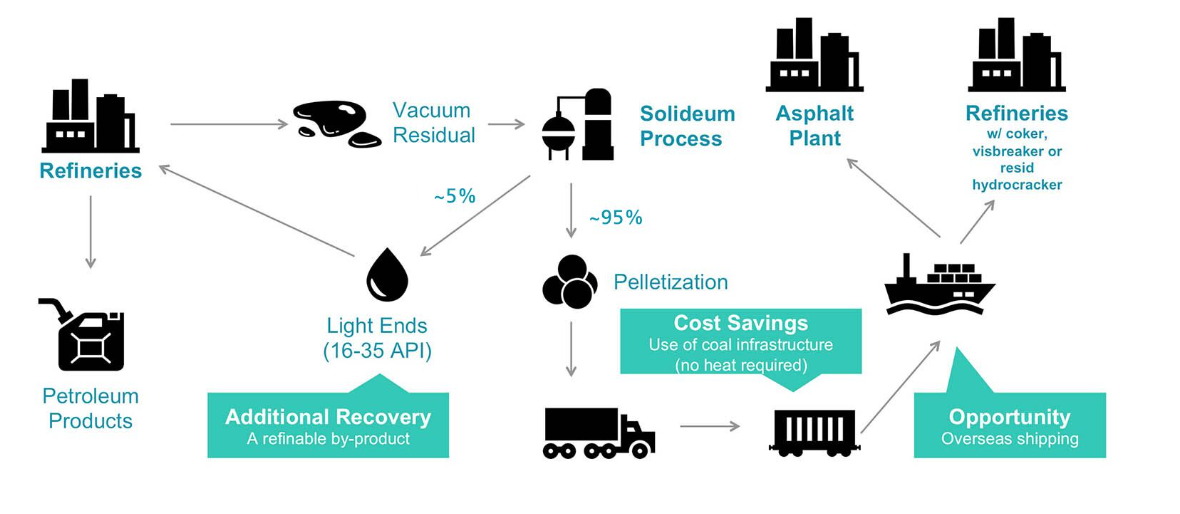
In addition, it has been providing funding and guidance to startup companies and research teams developing technologies to turn bitumen-derived asphalt binder into a solid form to allow its economic shipment to more distant markets in unheated rail cars and ocean-going bulk carriers. This includes Calgary-based Solideum Inc., possibly the outfit closest to commercializing a technology.
Here, in Part 2, results related to the asphalt binder benchmarking study and the market study will be discussed, while an update on Solideum’s project will be provided based on an interview with Ian Gates, the company’s chief operating officer and a petroleum and chemical engineering professor at the University of Calgary.
Premium asphalt binder
“Asphalt binder from Alberta bitumen is the best quality asphalt in the world with the only comparable being asphalt binder from Venezuela,” Bomben said, based on results from the asphalt binder benchmarking study.
The study, by Simon Hesp, a professor of chemistry at Queen’s University — a long-time researcher of asphalt binder — compared binder derived from the three main oilsands regions (Athabasca, Cold Lake and Peace River) produced by a range of recovery methods (mining, CCS, CHOPS and SAGD) to asphalt binder made from crude oil produced elsewhere in the world.
“It was demonstrated that they [Alberta bitumen-derived binders] provide superior performance in terms of cracking resistance when compared with materials sourced from elsewhere,” Hesp wrote. “The superior performance comes for the most part from their exceptionally low wax contents in combination with moderate to high asphaltene contents, providing high quality and durability.”
The only binder found to have “similarly desirable and balanced properties” was obtained from a Laguna, Venezuela crude.
Asphalt binders high in paraffin wax are stiffer in cold temperatures, reducing adhesion and promoting cracking, according to Hesp. Binder produced from Alberta bitumen is “optimal” because it has minimal wax and its composition is more-or-less uniform, reducing pavement cracking by up to 50 per cent.
Based on additional research by Hesp, roads using binder made from Alberta bitumen can be “good” for up to 40 years, compared to just 10 years in New England states, where low-quality binders are used.
Another advantage of Alberta bitumen-derived binders, according to Hesp, is its low wax content makes asphalt produced with it ideal for recycling, giving it another 30 years of life.
On the other hand, asphalt binder made from Alberta bitumen is relatively high cost at $800 to $900 per tonne — one tonne of binder produces about 20 tonnes of asphalt mix — roughly twice as much as low-cost, low-quality binders.
Potential new markets
For the asphalt binder market study, Alberta Innovates had Houston-based ADI Analytics do a deep dive on the Asian and U.S. markets based on voice-of-customer interviews because these are logical — due to proximity — and attractive new markets for solid binder material made from Alberta bitumen.
As of 2020, Asia accounted for over a quarter of global asphalt demand at 39 million tonnes and the U.S. almost a fifth at about 27 million tonnes, while the two markets are expected to grow by over three per cent annually during the 2020 to 2025 period —compared to a global average of 3.6 per cent.
“In Asia, Canadian asphalt has the best application opportunities in expressways, highways, and some airports and North American [read: U.S.] application opportunities for Canadian asphalt are led by interstate highways, city roads, and airports,” ADI wrote.
In addition, Asian customers identified product quality as the third most important factor for selecting binder suppliers — after relationships with the suppliers and binder pricing — while American customers pegged product quality as the second most important factor after binder pricing.
And given Asia and the U.S. are two of the three fastest growing markets for electric vehicles along with Europe, and recycled asphalt pavement (RAP) is gaining increasing share of the market in both of these regions — a little over 20 per cent of total asphalt demand in the U.S. and less than five per cent but rising in key Asian countries — binder quality should become an increasingly important factor in the future in each.
As a result, ADI concluded that “Canadian producers of asphalt binders will have to invest in educating end-users and the broader market around the value of selecting suppliers based on performance outcomes in order to identify new opportunities and differentiate themselves against growing competition.”
Solideum Inc.
Solideum has developed an upgrading/degrading technology to process heavy oil, bitumen and dilbit into a light cut (API gravity of 33+) and a heavy cut (API gravity below 5), with the ability turn the heavy cut into three forms of solids — pellets, flakes and spaghetti; the latter the easiest and lowest cost option — for transport to more distant asphalt binder markets.
The company has scaled up a 100 b/d pilot project in Bonnyville —partly funded by Alberta Innovates — to 500 b/d, with its technology achieving excellent results, according to Gates.
“We have no major technical risks at this time, and we keep advancing the technology,” he said. “Solideum has a 2 b/d lab unit and the 500 b/d field unit, and we have been demonstrating the technology to potential clients using both units.”
“The major hurdle we face is that clients want a completely de-risked technology but at this point, we don’t have a commercial unit that has had extended running time,” Gates added.
Solideum’s technology is expected to be commercial at a scale from 1,000 b/d to 10,000 b/d,
“Given the potential for BBC as a route for Alberta to move heavy oil and bitumen to fixed carbon products such as asphalt, we believe that heavy oil and bitumen producers will be seeking solutions such as Solideum’s technology to diversify and reduce their Scope 3 emissions,” he said.
Although not mentioning Solideum directly, Bomben said these sorts of technologies are likely a few years away from commercialization.