Low Carbon Solutions UCalgary Start-Up Pioneers Oilsands Carbon Fibre Manufacturing Process
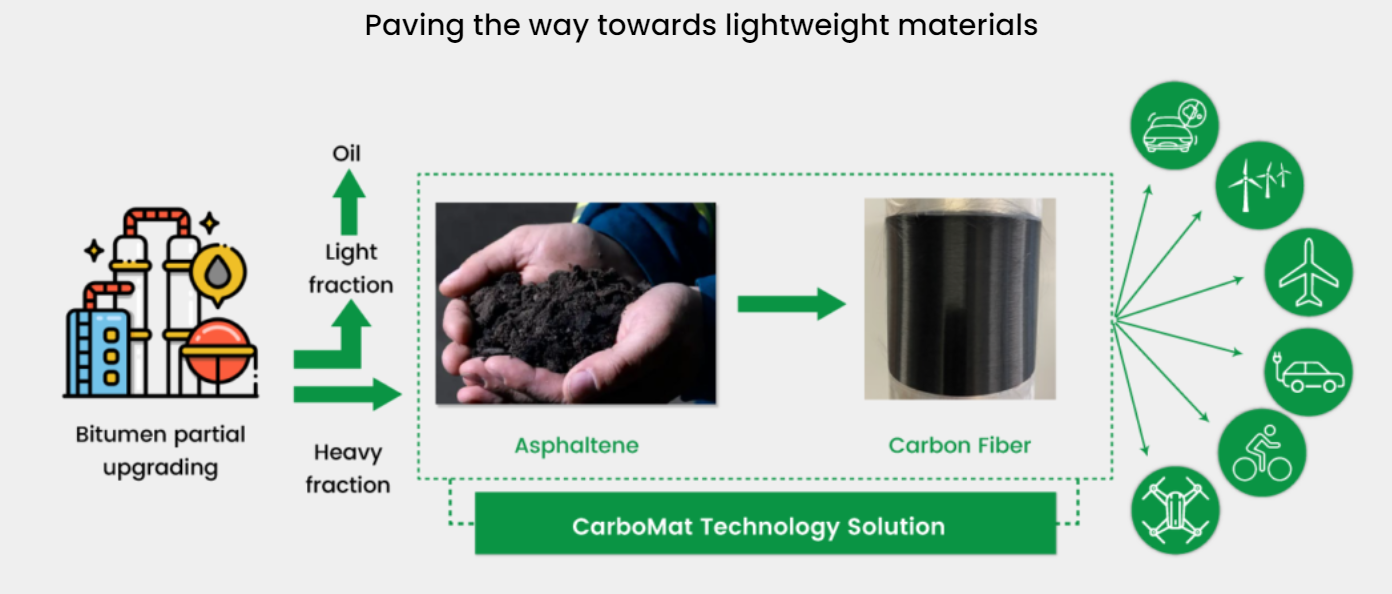
CarboMat Inc. is pioneering a carbon fibre production method, turning its academic research into an innovative venture poised to unlock new markets and increase the value of Alberta bitumen.
Its current company’s $5.1 million development project aims to manufacture low-cost, high-value carbon fibres from oilsands petroleum asphaltenes.
“If we talk about the downstream market, basically the market opportunity for carbon fibres is massive right now,” Shabab Saad, chief executive officer and co-founder, told the DOB. Currently, he said, global carbon fibre demand is around 150,000 tonnes per year. However, with low-cost carbon production, he sees that demand increasing.
“We are at a point where we need to unlock market opportunities if we want to have sustainable materials as a supply over the next 10 years. That’s where CarboMat comes in, where we produce low-cost carbon fibres to unlock at least five to seven different, new markets.”
The University of Calgary chemical engineer began working on the technology behind the start-up with co-founder and scientific director Md Kibria in 2020 as part of the Alberta Innovates Carbon Fibre Grand Challenge (CFGC) Phase I. In six months, they completed a proof-of-concept study, with $50,000 in funding, to see if Alberta oilsands asphaltenes could be used to make carbon fibres. In 2021, the team received more than $500,000 in Phase II funding.
“Phase II was a long time. It started in 2021 and ended in Q4 2023,” Saad said. “During that period, we worked on developing a prototype, which is a [scaled-up] production facility to produce carbon fibres from Alberta asphaltenes.
“While doing that, we were getting some consistent results. We were able to produce at a decent uniform capacity every day. That’s when we started realizing this is potentially a good opportunity to commercialize.”
In 2022, the federal GRInSTEM Fellowship Award provided $250,000 to help support incorporation, which is how CarboMat spun out from the U of C, basically helping with multiple day-to-day company operations.
“That award is about to end in July 2024. That gave us a good amount of runway to secure additional funds to run the business and finish some of the operating costs and take care of some of the salaries.”
The company is moving ahead with its $5.1 million development project, which aims to manufacture low-cost, high-value carbon fibres from oilsands asphaltenes. Backed by a $1.28 million funding contribution from Emissions Reduction Alberta (ERA), with its proprietary processing as demonstrated through CFGC, the three-year project will transform low-value materials into carbon fibres with impressive tensile strength and modulus.
“Within this three years, we have several milestones that we have to go out and put into place,” Saad said, adding that Alberta Innovates also will fund approximately $2.5 million of the development project, with CarboMat and its seven industry partners making up the difference.
“At least two of the milestones are actually related to scaling up on the whole process of carbon fibre manufacturing.”
Leveraging Alberta bitumen or asphaltenes for carbon fibre production offers a significant opportunity for the oilsands industry, the CEO noted, potentially multiplying the current value per barrel several-fold.
How it works
In order to tap its carbon fibre manufacturing potential, CarboMat first removes impurities through pre-treatment. Next, through melt spinning, CarboMat extrudes long fibre-like threads called ‘filaments’ from the asphaltenes. These are extremely thin — at around 10-15 microns. The filaments then undergo acid and high-temperature treatments. The end result: The filaments are converted into carbon fibres.
“The feedstock we basically use is Alberta oilsands asphaltenes. What are asphaltenes? They’re basically a waste byproduct of Alberta’s oilsands operations,” said Saad. “We call it a ‘waste byproduct’ because it does not have any direct market applications. It does not have any value right now in the market for any kind of applications. That’s why we call it a ‘low-value’ waste byproduct. But it has some good properties.”
He added: “CarboMat is the only [start-up] who has an end-to-end process — a whole technology where we start off with asphaltenes, we do all the treatments and processes to come up with the final product, which is carbon fibres.”
Relationships matter
Relationships have been essential along CarboMat’s entrepreneurial journey, Saad told the DOB. He highlighted how connections in academia, research and industry have facilitated resource utilization, mentorship and support. He stresses the significance of balancing academic and industrial ties, particularly in developing hard technology ventures such as carbon fibre production.
“Because of my relationships in academia and research, I’ve been able to utilize resources from the university effectively. You need those, at least, when you’re at low [technology readiness level],” he said, adding CarboMat currently is situated at the Creative Destruction Lab – Rockies at the U of C, where industry mentors offer support.
“It’s quite important, if you’re trying to build a company in Alberta, before you start to ensure you have a good lead in academia and research, and also that you have some good industry advisors, mentors and partners.”
Next steps
The UCalgary spinout’s technology, utilizing its modified melt-spinning technique, seeks to achieve a 60-per-cent reduction in carbon fibre production costs and a 50-per-cent drop in greenhouse gas emissions compared to current industry practices. The success of this project aims to diversify Alberta’s energy industry, creating employment opportunities, and establishing a burgeoning carbon fibre sector with significant revenue growth potential.
“Right now, my vision is to actually grow CarboMat to a point where we would be commercially producing carbon fibres in Alberta,” Saad said, adding he aims to complete the pilot-scale facility within 2026, ideally with it running by Q4 2025.
“The next step would be a development plant. Right now, that’s expected to come some time in 2027. That development plant will be an upgraded version of the pilot, which would run at a much higher capacity.”
He added: “The final step would be the commercial production facility, which will be very similar to a commercial carbon production line, which would be running at around 200,000 tonnes per year. Right now, I’m expecting that to come sometime in 2030 — hopefully, by Q4 2030.”
As the firm intends to grow three to five times its current size in the next three to five years, and with the eventual commercial scale-up, Saad anticipates the current staff of three or four will grow to 70 to 100 employees in all different departments at CarboMat. While Alberta oilsands producers are a reliable source of asphaltenes, he noted, the company is also looking at re-risking its supplies through discussions with oil and gas producers in the U.S. and Middle East.
“My experience has been quite exciting, interesting and valuable because of the relationships I’ve developed over multiple years working in research, academia and now industry.”