Natural gas/LNG Murphy Tests New Completions Style At Tupper Montney, Will Consider Short-Cycle Options For The Play
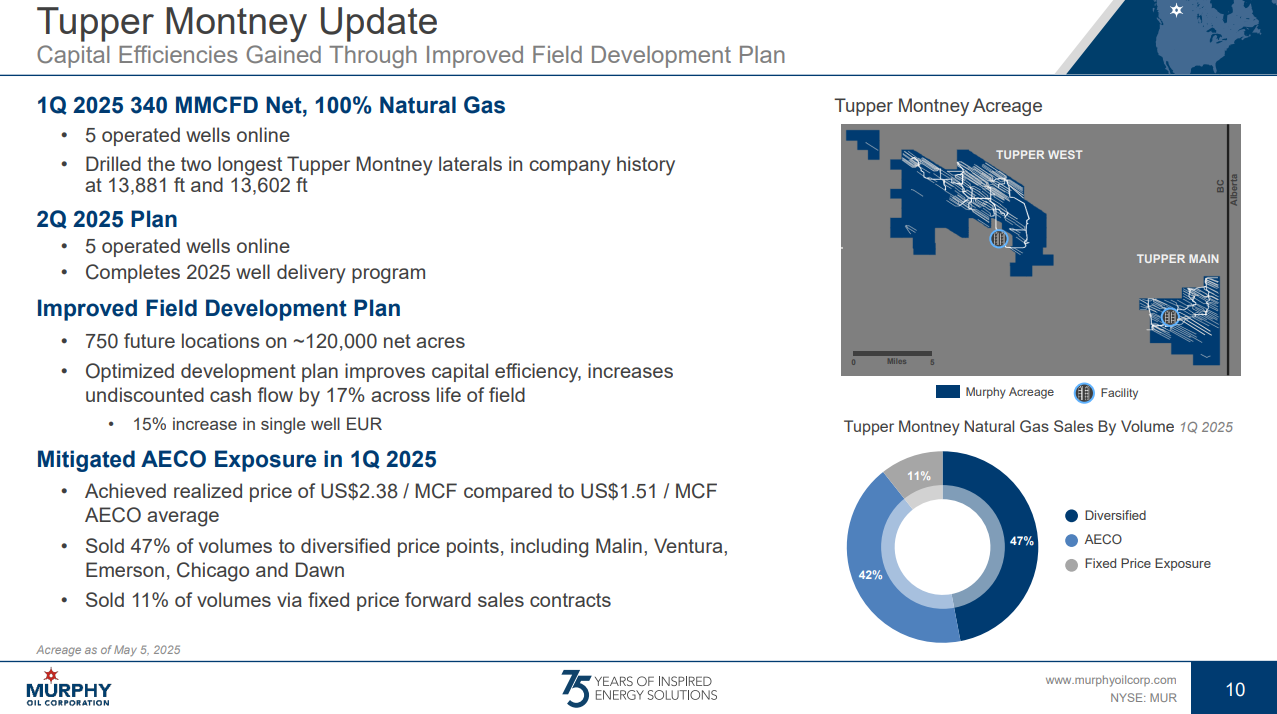
Murphy Oil Corporation has tested a new completions method in the Tupper Montney that uses enhanced proppant loading.
“We are pleased with the early results and we’ve seen more than [a] 30 per cent increase in initial production rates compared to our historical performance,” Chris Lorino, senior vice-president of operations, said Thursday on a conference call to discuss Q1 results.
Murphy also recently drilled its two longest Tupper Montney laterals in company history, at 13,881 feet and 13,602 feet.
The longest represents a nearly four per cent increase from the previous record, Lorino said.
In Q1, Murphy produced 340 mmcf per day, or 57,000 boe/d, from Tupper Montney and brought online five operated wells, as planned.
The remaining five wells of its 2025 Tupper program came online early in the second quarter, which wraps up its well delivery schedule in the area for the year.
With the new wells now online, Murphy has reached capacity on the Tupper West plant and is currently producing nearly 500 mmcf/d from the Tupper Montney asset.
Tupper Montney – short-cycle options
In a world where oil prices soften but natural gas prices stay strong or improve further, Murphy executives were asked on the conference call what milestones or benchmarks they’d assess to consider more investment in Tupper Montney operations.
“We do have a plant capacity issue. Tupper West is full,” Eric Hambly, president and chief executive officer, said on the earnings call. “The ability to add more there in the really short run is limited.”
However, Hambly noted there could be a scenario where the company sees a commodity price signal that would cause it “to have more investment in [Tupper] wells. So we maintain the plant full for a longer part of the year.”
After a new crop of wells come online in the winter, the plant typically stays full for a while, but volumes decrease after a few months as wells decline from their peaks.
“So we could potentially have another pad of wells — another five wells, or three wells — that could allow us to maintain our plant at a higher capacity. That’s something we could do on a fairly short cycle.
“That’s something we think about, we model, we evaluate.”
Hambly said the company will monitor if Canadian gas prices improve materially in the second half of 2025 with LNG Canada finally taking some volumes to the west.
“The concern I have, and we’ve been fairly careful about, is historically with a high price signal every single player in Western Canada has pretty significant capital efficiency, and they spend money to bring on new wells and the gas price is negatively affected.”
That said, Hambly noted the capital efficiency of Murphy’s Tupper wells is “tremendous.”
“We’re getting wells this year that are producing, early days, 17 to 25 mmcf per day. These wells cost us about $5 million to $5.5 million. And so it’s pretty easy to spend that … if we saw a high enough gas price.
“So it’s something we’re going to be watching carefully and if we think there’s a durable higher price then we have a great opportunity to short-cycle invest into that, but we’re going to be watching the larger, macro issues pretty carefully before making that decision.”
Kaybob Duvernay
Duvernay production averaged 4,000 boe/d in Q1, with 58 per cent oil volumes and 71 per cent liquids volumes.
Murphy progressed its well delivery program during the quarter and remains on track to bring four operated wells online in the third quarter.
In addition, Lorino said the company plans to drill two operated wells in the fourth quarter that will be completed in 2026.
Offshore Canada
In the first quarter, production averaged 9,000 boe/d in the non-operated Canadian offshore, consisting of 100 per cent oil.
During the quarter, there was 2,100 boe/d of production curtailments due to temporary logistics challenges.
Company guidance
At present, the company is maintaining its full-year 2025 guidance. Total production is expected to range between 174,500 and 182,500 boe/d, with US$1.135–$1.285 billion of accrued capex.
“At this time, we think it’s appropriate to maintain to our 2025 capital plan,” Hambly said on the call.
“We’ve made significant progress in deleveraging our balance sheet, and in general we want to position ourselves to continue investing in high returning exploration and development projects through near-term volatility and be positioned to capture upside to commodity prices in the future.”
The company has identified opportunities to significantly reduce spending in 2025, however, if it looks like oil prices will be below US$55/bbl for the remainder of the year.
The company would delay drilling Eagle Ford shale wells in the third and fourth quarter, which are designed to come online in early 2026.
“We could [choose to] not complete our four-well Kaybob Duvernay pad that we’re nearly done drilling,” Hambly added. “We could not begin drilling in the Tupper Montney and the Kaybob Duvernay in the fourth quarter, which is our plan for the year, to get a head-start on the winter drilling season.”
And while the company would also drop its planned development well activity in the Gulf of Mexico, it is unlikely to stop development activity in its Vietnam operations.
“Those changes would have very limited impact to our 2025 production profile, but they would have a more significant impact to 2026, so we’re going to watch the situation carefully and evaluate.”
When considering its budget for 2026, if prices are below that $55/bbl-threshold, Murphy would likely reduce its capex by 20–40 per cent from the $1.1–$1.3 billion it has previous outlined.