Low Carbon Solutions LithiumBank Executive Outlines Plans For Large Calgary Pilot Project
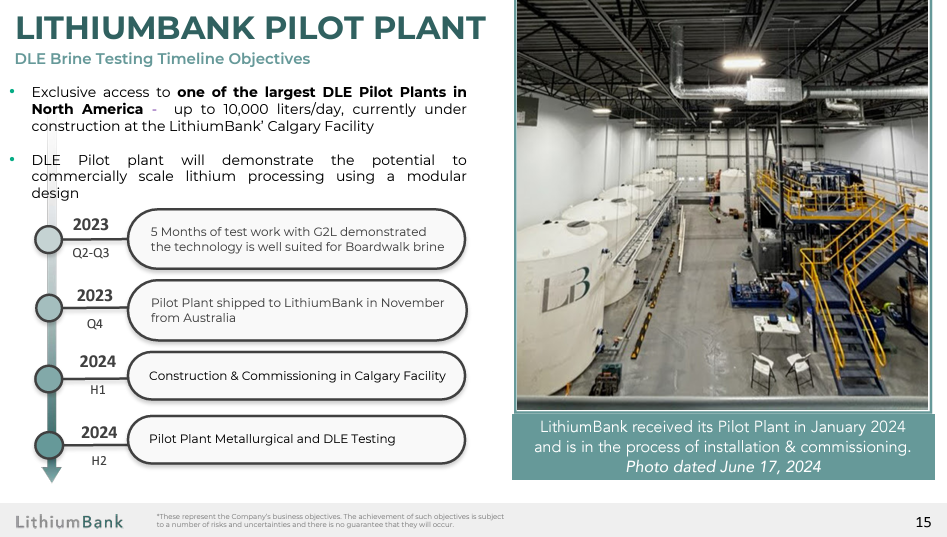
Vancouver-headquartered LithiumBank Resources Corp. will begin piloting this month at a Calgary plant projected to process 10,000 litres per day of lithium-containing brines.
According to LithiumBank, this makes it one of the largest DLE pilot plants in North America.
Talking to DOB Energy, Kevin Piepgrass, LithiumBank’s chief operating officer, called it a “really sizeable pilot.”
The DLE pilot plant will demonstrate the potential to commercially scale lithium processing using a modular design.
“The things we have seen, other companies in Saskatchewan and Alberta are typically about a third the size of that, so like 250 to 300 litres per day,” he added. “Much smaller throughput and much smaller piping.”
On why there’s a need to go big with this pilot, Piepgrass noted that “having a large pilot plant is important as the larger it is, the less guesswork is involved when determining how the process would work at a commercial scale for a feasibility study.”
The pilot program is slated to last up to 18 months. Its results are expected to contribute to the feasibility phase of the company’s development plans.
In September 2023, Go2Lithium Inc (G2L) announced its agreement with LithiumBank under which G2L will license its continuous DLE technology to support development of LithiumBank’s lithium brine assets in North America.
G2L is a joint venture between Computational Geosciences Inc, a subsidiary of Ivanhoe Electric Inc. and Clean TeQ Water Holdings.
This followed an 18-month process working with Hatch, testing DLE technology to determine which worked well for brine from LithiumBank’s assets.
Testing application of technology from G2L, showed “favourable economics” on LithiumBank’s Boardwalk asset, for which a preliminary economic assessment was completed.
In a prepared statement, Livia Mahler, chief executive officer of Go2Lithium, said the pilot plant employs advanced lithium extraction technology that is expected to set new standards in sustainability and efficiency within the industry.
“The cDLE technology underscores our commitment to environmental responsibility, minimizing ecological impact while maximizing resource utilization,” she added.
This proprietary process has been adapted from experience in continuous ion exchange related to other metal recovery applications in the mining industry, according to G2L’s website.
The pilot will test brine from the Boardwalk and Park Place Alberta assets, along with samples from Saskatchewan, where it has assets, as well. Piepgrass characterized this collection an “embarrassment of riches.”
“In 2019, we went out as an exploration company and staked about 4 million acres in Alberta and sampled multiple different reservoirs, multiple different locations across Alberta that we thought might have a possibility to host sizeable lithium reserves,” said Piepgrass.
“Through exploration, we determined that Boardwalk and Park Place were the best two properties in the province. We elected to keep those and trim everything else down.”
He singled out their size, scalability, thickness, porosity and deliverability of brine to the surface.
“They are really beasts as far as reservoirs are concerned,” continued Piepgrass.
The total inferred mineral resource for the Park Place project is 21,681,000 tonnes lithium carbonate equivalent (LCE) between the two formations contained within the license boundaries with a combined average grade of 80.2 mg/L lithium.
LithiumBank's collective lithium brine resources inventory for its Alberta projects reaches 27.78 million tonnes LCE.
“It is a huge inventory of resources and one of the best jurisdictions in the world, for sure, for this purpose,” said Piepgrass.