Low Carbon Solutions Innovation Centre Explores B.C.’s Potential For Energy Storage
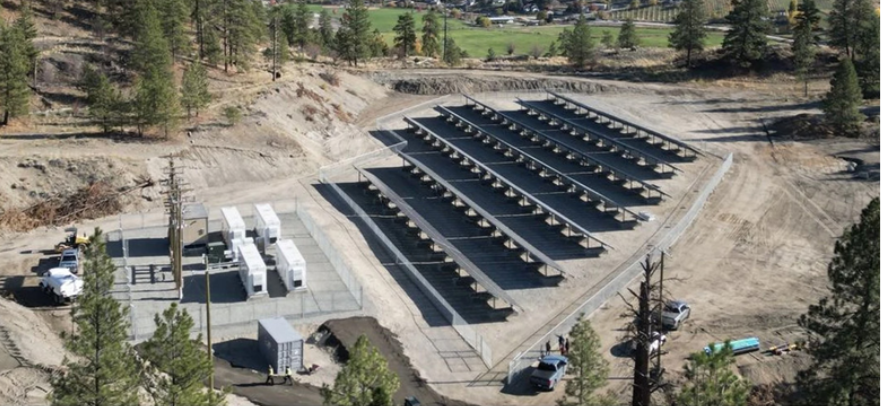
Although renewables have changed the electricity market significantly in the past decade, the B.C. Centre for Innovation and Clean Energy (CICE) is exploring how technical advancements and trends in energy storage could make adoption even more attractive.
Michael Delage, an engineer and cleantech consultant, presented the CICE findings of a report, Powering the Future with Energy Storage, in a recent webinar.
He showed how energy storage innovations improve variable renewable energy generation such as wind and solar, and what this means for electrification in buildings, heating, transportation and other major carbon-emitting industries in British Columbia.
With costs per $/MW dropping by eight times for solar and by two times in the case of onshore wind in the past decade, market penetration has been rising simultaneously — worldwide capacity by 10 times for solar, by two times for wind.
So, despite renewables’ variability, meaning there are times when they aren't producing energy at all, their cost profile remains attractive, Delage said.
“Operating costs for wind or solar are essentially zero. These are capex investments, and once built, because of their low opex, the marginal cost of electricity they produce is very, very low. It can be down to almost zero,” Delage said.
He added that deployment options for such technology is also promising.
“[What] is quite different from traditional generation is deployment scale [compared to nuclear or coal-powered plants, for example]. Even with wind turbines that are at the most 15 to 18 megawatts in size… that allows for renewable generation to be located in a lot of different places.”
This means they can be more easily located near the end of major transmission systems or “anywhere on a grid.”
And in terms of energy storage, the right systems will help the viability and attractiveness of these developments, he said.
Preserving generated energy in battery storage
Delage said that one of the biggest opportunities for energy storage comes out of the challenges of arbitrage of the buy-and-selling market for energy depending on the time of day of usage.
“When thinking of time-shifting energy, if you’re an engineer you think about [having] sun during the day but [needing] electricity at night, so we're going to charge up the battery storing and discharge at night. If you're an economist you say during the day we have too much energy and the prices are low, but at night there's not enough and the prices are high,” he said.
“Arbitrage is really the number one application when you think about energy storage and that not only on an hourly or daily basis but we'll see it goes into longer-term. … Price is always going to be part of the economic model for an energy storage system.”
As well, there is peaking capacity in which an energy storage system owner decides when to charge or discharge depending on price.
“Lastly… you see increasing amount of energy storage systems being built paired with new renewable generation, and that's because capacity markets operate in a lot of places where generation is paid to be available when needed, and it's really difficult for renewables on their own to participate in capacity markets,” Delage said.
“The combination of energy storage with renewables allows for participation in capacity markets as a revenue stream.”
What does storage mean for British Columbia?
Delage said that since B.C. is driven especially by hydro generation, the province is in a fortunate place.
“Flexibility in that grid has allowed BC Hydro in energy trading to make a lot of money for British Columbia residents over the years, because it can be that adaptive generation source on the grid in a system that connects with all of western North America,” he said.
For the future, BC Hydro has identified that there are going to be challenges in the network, and one of the areas that is particularly important is going to be the transmission constraints.
“And so the big opportunity here is we look — and BC Hydro's got a call for power out — is that as we potentially have renewables coming in, variable renewables — wind and solar — coming into British Columbia in an increasing level, the hydro system is going to be able to adapt and absorb the intermittency, from an energy point of view,” Delage said.
The challenge is really “more so about how do you move that energy into where the centres of demand are, and the constraints on transmission lines.”
According to the report, with most of B.C.’s electricity demand based in the South Coast region, and most of its hydrogeneration capacity in the interior, BC Hydro can defer costly upgrades to transmission lines by “locating energy storage on the South Coast.”
“By charging the energy storage from the transmission system during off-peak hours, and discharging it during times of peak demand, BC Hydro will use energy storage to augment the supply coming through the transmission system.”
The report added: “In remote communities, energy storage paired with solar and wind generation can provide resilience and significantly reduce the consumption of expensive diesel fuel by traditional generators.”