Exclusive A Promise Of New Horizons As Trans Mountain’s Pipeline Expansion Set To Show What It Can Do
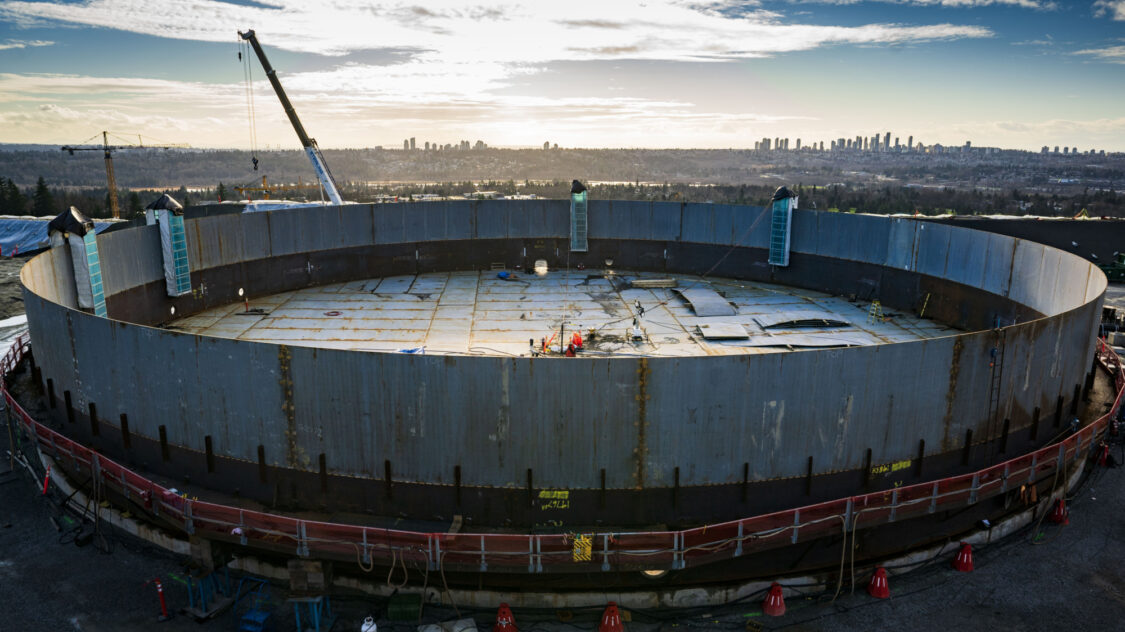
With the arrival of May 1, Trans Mountain Corporation’s $34-billion, much-delayed pipeline expansion enters its most important stage yet.
Prior to the Canada Energy Regulator (CER) granting the final permits on April 30, chief financial and strategy officer Mark Maki, and senior director of business development Jason Balasch, talked to DOB Energy about ramping up pipeline operations, the impact on the company and the Canadian oil industry, the higher tolling rates, and encouraging WTI/WCS price differential shifts.
Maki said in the run-up to the official launch, they’d been following a screen that showed growing amounts of oil moving in the pipeline throughout April, and “making good progress.”
“In terms of the company, the gang here is extraordinarily excited about having the chance to be a part of the next big pipeline expansion in Western Canada…. You’ll see an improvement in pricing for the producing community here in Western Canada which is fantastic news,” Maki said.
“We're excited about what it means for the basin, what it means for access for Canadian barrels to the Pacific markets at a time when the focus is very much on energy and security, and Canada is a wonderful partner for that.
“For [Alberta] it’s great news, for the people in the producing community we think it’s great news, so we’re very happy for where we’re at.”
The company itself will also be transformed, with the additional 590,000 bbls/d added to its current 300,000 bbls/d, simultaneously more than tripling Trans Mountain’s EBITDA, said Balasch.
“And then from a contractual basis we’re much more of a commercial entity now than in the past,” Balasch added.
Maki said Trans Mountain will change from being a relatively small midstream player in the western Canadian environment to being a bigger, more international one, but believed it retains its small company feel.
After May 1’s kick-off
Maki said the 1,150-kilometre pipeline will fill up in sections, “think of almost like a series of box cars in a train,” reaching capacity by around mid-May as it flows on its way to Burnaby, B.C.’s Westridge Marine Terminal. There, ships sized up to Aframax class will be waiting to load up.
Balasch said the expanded oil tanker system will see a turnaround of about one a day once everything is in full operation. The terminal has a maximum capacity of 630,000 bbls/d.
“Once it hits Burnaby, basically the system is ready to roll. The docks are all ready, and have been running for a while, so the ability to load tankers is there,” Maki said.
“We’ll be in a position where basically the full capacity is there right away, but how much is utilized right away, it will take probably a little while for the markets to sort out.”
Balasch said they are expecting ship loading from the expanded pipeline to become steadier in the second half of May, and there will be “reasonably steady” tanker numbers after that, with more in June.
The process will become regularized over the following weeks.
Maki and Balasch also said the Trudeau government should not rush to put Trans Mountain on the market, with Maki saying: “Keep in mind that short term in the corporate world and short term in the government world are two entirely different things, so the government should be in no hurry to do anything to sell the system until it feels like any uncertainties that are there are out of the system.”
The complexity of the project slowed the work
Asked if there were any other overruns expected, and if it would have been technically easier without all the requirements that TMX had to contend with as the pipeline was being built, Maki said the challenges showed the complexity of long-linear infrastructure.
“Hopefully through this experience, there are learnings that apply to future long linear infrastructure, whatever it happens to be. But there were a lot of requirements that Trans Mountain had to contend with, there are a lot of exogenous things Trans Mountain had to contend with, fires, floods, COVID, those are just a few, and those were massively disruptive,” Maki said.
In late April, in another example, the Financial Post reported the discovery of about 250,000 artifacts during the pipeline’s construction.
Maki called it “as responsibly constructed a pipeline as there is anywhere on the planet.”
“In terms of the respecting of the archaeological and the histories of the First Nations, the natural resources, whether birds, amphibians, snails, you name it, it was protected in the right way,” he said.
“We can hold our heads up on how this thing was done…. Did that make it more expensive? Absolutely, but that’s the reality we live in.”
Tolling remains contentious
An increased tariff and tolls begin on May 1 for all shippers. Maki said he was irritated by a recent letter sent by oil shippers, led by Suncor Energy Inc., to the CER, which expressed objections over the new rates, and questioned whether Trans Mountain will be able to make contracted crude supply volumes on schedule.
“The tolling that we currently have on file with the CER, the commencement day toll, what’s proposed, is what we’re defending currently in the rate proceeding there,” Maki said.
“There likely will be some tweaks to that number, but we’ll figure that out as the process unfolds in front of the regulator.”
WCS flowing to port within Canada
In terms of heavy oil price differentials and the lessening of the pricing gulf between WTI and WCS, Balasch said the benefit had always been expected.
“But to see it in advance — and I think a lot of people can assume it’s in anticipation of us starting that kind of legitimizes it, and also that bullish sentiment that pervades the industry right now in production growth, that impacts us in terms of expecting more volume and starting to think about debottlenecking,” Balasch said.
“How do we squeeze more through here, and are there expansion cases that the industry as a whole is starting to talk about? There is a line of sight to being pipeline capacity constrained again, so we’re factoring that into our long-term business development and our strategy.”
Maki said what was developing for Canadian oil reminded him of conditions earlier in his career, and being told pipelines built then were the final expansions that were “ever going to happen.”
“The difference always has been we’ve been hostage effectively to the middle of the United States, and now what [the pipeline expansion] does is it brings in new markets. I think that’s a big difference and a big helper,” said Maki.
“If you think about the strategy of some of the big legacy pipelines, [Enbridge Inc.] included, it was get to the Gulf Coast, to the U.S., get on a boat, and go somewhere else.
“So, this is the same thing, but the logical market for heavy oil is Asia, and to a degree, California is mentioned. This is a much more direct route there, and [with the] way shorter tanker time, logistics are simpler.”
American by birth and now a dual citizen, Maki recalled the impact of Canadian oil turning up at Texas refineries decades ago.
“When I was working in Texas and Canadian oil started showing up, the local producers, the independents, were more of a mind of ‘What is this stuff?’ and ‘What’s it doing here?’
“There's a protectionist bent to the country, right? Look no further than Keystone XL. [The] political killed it,” Maki said.
“[The Trans Mountain pipeline] is really important to Canada…. It’s all inside this country.”