Sponsored Tools Available To Help Drought Proof Oil And Gas Operations
With the ongoing drought and water use restrictions looming in some areas of Alberta, water availability for oil and gas operations is becoming a critical concern.
But by understanding the regulatory environment and leveraging available water data operators can lessen their risks and help ensure necessary operations are completed if the drought persists.
In February, the Alberta government authorized its drought command team to begin negotiations with major water licence holders to strike water-sharing agreements in the Red Deer River, Bow River and Old Man River basins.
The water sharing effort is focused on the South Saskatchewan River Basin in part due to the vital role water storage plays in these watersheds, with current stored levels well below normal, said Steve Herman, director of engineering for WaterSMART Solutions.
However, many other regions are facing historic low water levels. For example, the Smoky River and Wapiti River in the north recorded flows at their lowest in the last 25 years in late January. Other areas throughout the province are facing much lower surface water levels than normal, and are likely to have lower flows throughout 2024.
The extent to which this will be problematic for water users in those locations comes down to watershed-specific context, and what proportion of the water has been allocated for use, said Herman. It also depends on the terms and conditions of the licences.
“Many licences for upstream oil and gas will have diversion schedules, via which the rates at which water can be diverted are directly linked to river levels,” he explained. “When water flows fall below defined thresholds, diversions are incrementally restricted, and could eventually be cut off altogether for a period of time when flows are low enough.”
Oil and gas operators often access groundwater for operations when it makes economic sense. How the drought could impact these operators is more complex, said Herman.
“It really depends on the details of the groundwater licence,” he noted. “For example, shallow groundwater licences which demonstrate strong connectivity to surface water sources may be licensed and regulated as if they were surface water. This means diversions could be restricted when flows in the adjacent or connected river are low.”
Groundwater sources which are disconnected from the surface typically don’t have diversion restrictions directly tied to surface water behaviour, but they often have limits on daily and annual diversion volumes related to sustainable withdrawal limits. If the drought persists for years, water yield from deeper groundwater sources could be impacted as they fail to recharge adequately.
“Groundwater users should review the details of their licences and their wells to better understand what risks they may face from water supply and regulatory perspectives,” he said.
Alberta utilizes a priority-based system for allocating the right to divert water, often referred to as “first in time, first in right,” said Herman. Older licences, called senior licences, have priority over newer licences, referred to as junior licences.
A senior licence holder is entitled to divert its entire allocation before a junior licence holder diverts any of their allocation. If a junior licence holder is upstream, it is required to leave water in the river for a senior licence holder to divert downstream.
There are also provisions for an emergency declaration, which gives the Alberta government powers to direct how much water is diverted and for what purpose.
Historically, the Alberta government hasn’t cut off junior users in times of persistent drought. Instead, licence holders in water-shortage situations have worked together to share water. A similar approach is being taken today, said Herman.
“In an oil and gas context, it’s important to recognize that temporary diversion licences (TDLs) do not have a priority within this system,” he said. “If water levels are low enough, the regulator may stop issuing TDLs and/or may suspend those which have been issued. Already, we’ve seen delays in the issuance of TDLs while the AER takes more time to review applications.”
Knowing who has water licences, how much water they are allocated, and how much of that allocation they are using can help oil and gas operators work with other licence holders in affected areas to build water sharing agreements and to avoid confrontations with other stakeholders, said Rhonda Gravel, senior technical advisor, Drilling and Completions, for geoLOGIC systems ltd.
“Opportunities for partnerships and collaboration within the oil and gas industry and between oil and gas companies and other industries exist if they have a clear understanding of the licensing breakdown in the individual watersheds,” Gravel said. “This includes knowing the licence holders and usage reported, as well as their unused allocation. There may be some licence holders that are not active participants in the water market.”
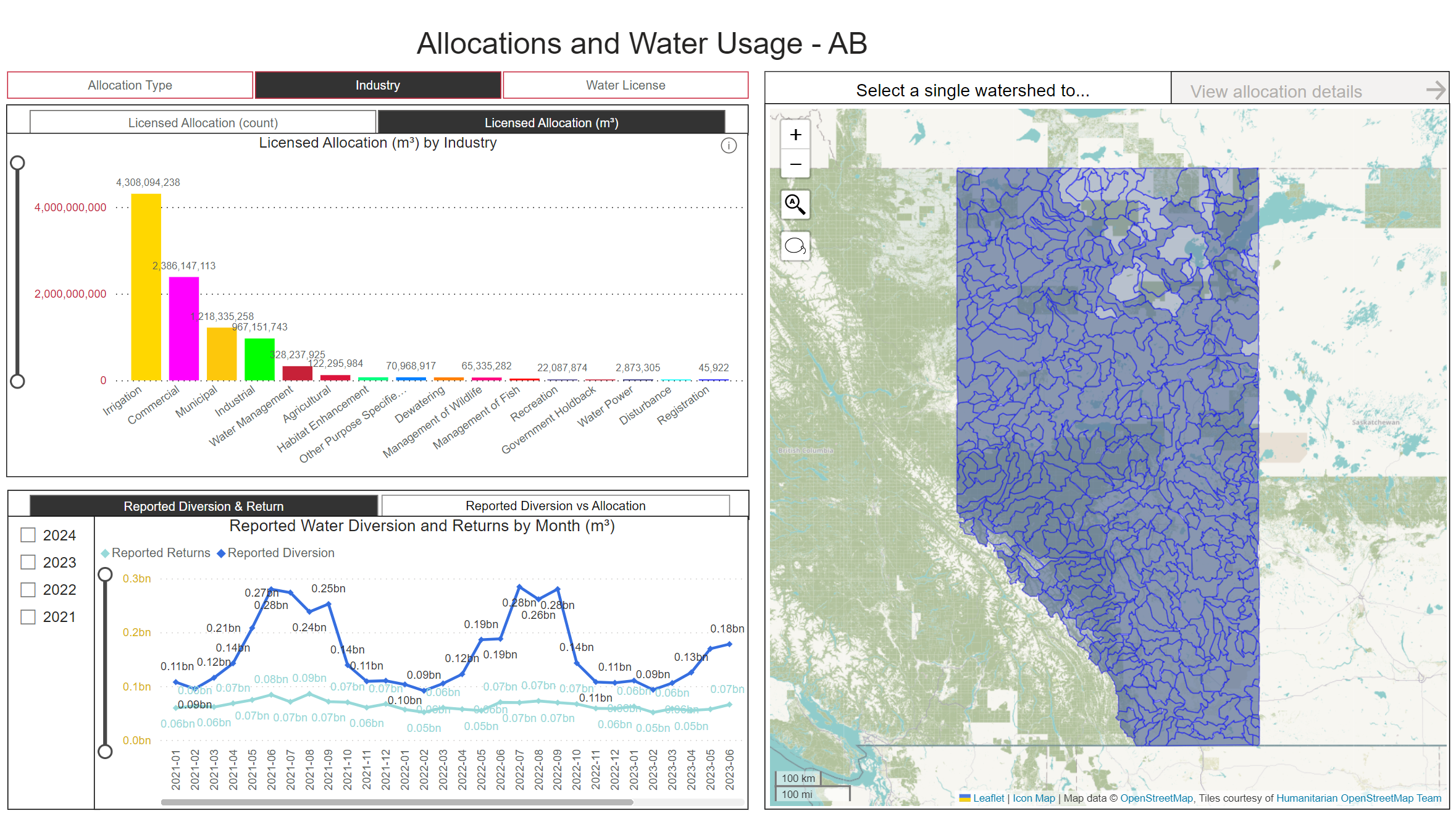
While the ongoing drought has shined a spotlight on water use issues, the government has been working to protect the province’s water resources, said Tanya Fagnan, product manager for geoLOGIC’s TOP Analysis and TOP Regulatory offerings. Fagnan led the team responsible for building the company’s water datasets which link together licences and water use by allocation. The data can be viewed through the gDC Water Allocations and Usage Dashboard or geospatially in geoSCOUT.
“Access to water use data is difficult to find,” said Fagnan. “Alberta has interactive tools to find water licences in a given area, but it is missing the actual water use reported towards those allocations. Our dashboard allows you to quickly determine who is using or not using their allotments.”
As Alberta updates its water management system, having access to data and geospatial tools to visualize that data will help oil and gas companies navigate the system, Fagnan added.
“New and renewed water licences will require the licence holder to report cumulative environmental effects annually within their drainage area,” she said. “Summarizing use from within a watershed for example, at the HUC8 level, requires a spatial dataset.”
On the demand side, it is critical to have both licence data and water use data — that is, knowledge of where water users are allowed to divert water and how much they are allowed, combined with knowledge of how much water they actually divert, said Herman.
On the supply side, robust modelling approaches can be used to simulate streamflow, and must be calibrated using observed data. The volumes available are also impacted by how much use is occurring.
“In combination, access to high quality water supply and demand data allows water managers to respond to water supply challenges, whether that’s in the context of a provincial drought response or simply when responding to natural variations in streamflow within and between years,” he said. “For individual water users, this data can inform water supply risks like the likelihood of being water short in any given year and approaches to mitigate the risk like modifying diversion timing and storing water for later use.”
The geoLOGIC Water Management Toolbox
To gain deeper insights, consider exploring our gDC Water Allocations and Usage Dashboard or tap into the water data seamlessly integrated with your existing workflows in geoSCOUT. Here’s what you’ll uncover:
- Individual Watersheds: Dive into the specifics of each watershed. Explore the licence holders, their allocations, and reported usage. This breakdown sheds light on unused allocations and identifies potential areas for partnerships and collaboration.
- Maximizing Efficiency: By understanding the gap between allocations and actual usage, you can optimize water management strategies. Whether you’re an operator, researcher, or policymaker, this knowledge empowers informed decision-making.
Connect with Us
Have questions about leveraging our Water Data? Reach out to us at Sales@geologic.com or give us a call at 1-855-870-1700. Let’s bridge the divide and ensure sustainable water practices for Alberta’s future.