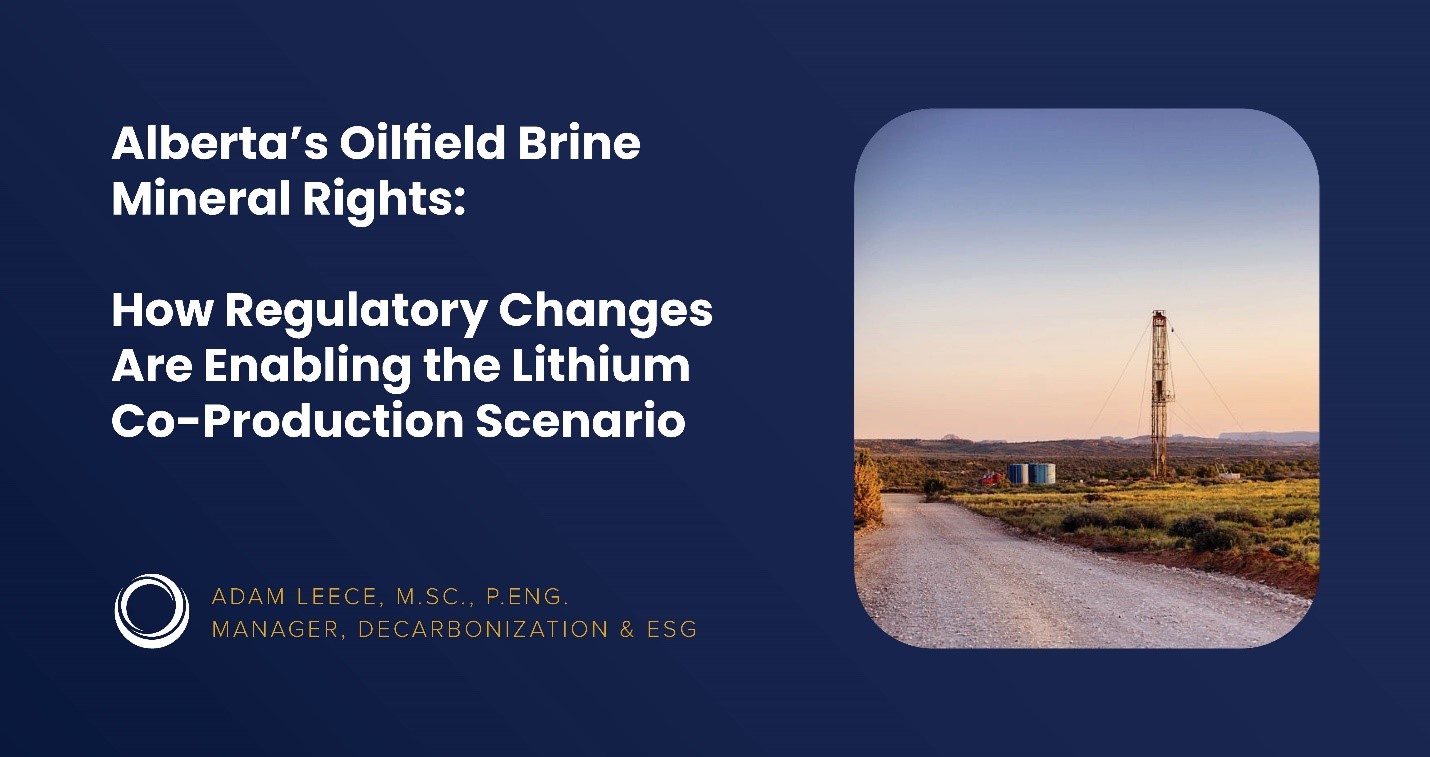
Sponsored Alberta’s Oilfield Brine Mineral Rights: How Regulatory Changes Are Enabling the Lithium Co-Production Scenario
Executive Summary
In 2023, the Government of Alberta released essential regulatory instruments enabling the extraction of critical minerals from deep geologic brine fluids.
This includes consideration for Lithium contained within produced waters associated with oil and gas operations.
As stated within the Federal and Provincial critical minerals strategies, establishing a domestic critical minerals resource supply is essential to support the development of domestic and global value chains and empower a clean and responsible global energy transition. While various tax and grant incentives have supported emerging resource exploration and technology testing, providing further clarity on the mineral tenure of both rock-hosted and brine-hosted minerals serves to mitigate an additional layer of uncertainty for prospective developers.
With suitable regulatory support forming in Alberta, there is a strong value-add case for right-sized Canadian oil and gas producers to consider from waste-production, which can support emissions intensity reductions and contribute to the circular economy. Scrutiny from ESG investors is only increasing as regulations and frameworks develop, and co-production can both help alleviate the environmental impact of Lithium and Petroleum products and reduce North American reliance on foreign critical minerals.
Adam Leece, Manager of Decarbonization and ESG at Integrated Sustainability, outlines the coordinated effort from policymakers, regulators, and investors to establish a regulatory roadmap and utilize the wealth of existing deep-pore infrastructure to fuel burgeoning Lithium demand.
Note: The Government of British Columbia is in the process of developing the regulatory mechanisms for critical mineral recovery from brines. To receive an analysis of BC regulations for produced water and deep aquifer brine mineral rights, please reach out to Adam Leece on LinkedIn or via email at Adam.Leece@IntegratedSustainability.com.
Developing Alberta’s Brine-Hosted Critical Minerals
In November 2021, the Government of Alberta (GOA) released their modern mineral strategy, Renewing Alberta's mineral future; a strategy to re-energize Alberta's minerals sector (the "AB Strategy") (Government of Alberta, 2021).
The AB Strategy emphasizes that Alberta possesses geologically favourable conditions for numerous metallic and industrial minerals, including but not limited to lithium, vanadium, nickel, and rare earth elements. While also recognizing the opportunity to extract minerals from conventional primary sources (ores and formation waters) or unconventional secondary sources (wastes/by-products from existing hydrocarbon developments, geothermal produced waters, oil sands waste streams).
As stated in the AB Strategy, its vision for Alberta is to become a preferred producer and supplier of minerals and mineral products and actively contribute to the global energy transformation. There are six key areas to support and achieve Alberta’s vision, including 1) increase public geoscience knowledge, 2) enhance the fiscal and regulatory environment 3) promote responsible development, 4) advance opportunities for Indigenous Peoples, 5) develop public awareness and a skilled workforce and, 6) promote innovation and industrial development.
As part of increasing public geoscience knowledge, the Alberta Geological Survey (AGS) has conducted research uncovering elevated levels of lithium in geological formation waters, notably within the lithium-rich brines of Devonian aquifers in various areas of Alberta, including Fox Creek, Grande Prairie, Leduc, Red Deer, and the Swan Hills region Additional investigations by Natural Resources Canada have also highlighted the possibility of lithium-enriched waters in the production waters of Duvernay and Montney regions in Northwest Alberta.
Since the release of the strategy, and to enhance the fiscal and regulatory environment, the GOA has now produced several accompanying guides, plans, and regulatory instruments to enable development:
- Alberta's Critical Mineral Potential (Government of Alberta, 2023) replacing the former: Critical minerals in Alberta.
- Brine-hosted Mineral Resource Development Rules (BMDR) (Government of Alberta, 2023a)
- Mineral Resource Development Act (MRDA) (Government of Alberta, 2023b)
- Amendments to the Metallic and Industrial Minerals Tenure Regulation (Government of Alberta, 2022)
At present, the MRDA empowers the Alberta Energy Regulator (AER) as the regulator with authority to provide for the safe, efficient, orderly, and environmentally responsible development of Alberta’s mineral resources, including a lithium recovery project utilizing formation or co-produced brines. The AER is responsible for evaluating, permitting, and auditing wells, associated facilities and pipelines throughout the project life cycle, from initiation to decommissioning and reclamation. The regulatory framework for this oversight is outlined in the MRDA.
In conjunction, Alberta Energy and Minerals oversee and issue mineral tenure and administer metallic and industrial minerals royalties. The Tenure Regulation and royalty regime have been amended such that brine-hosted mineral tenure is required to produce lithium via a brine-hosted mineral lease or brine-hosted mineral licence.
The new Metallic and Industrial Minerals Tenure Regulation has been in force since January 1, 2023. Currently, the rock-hosted mineral permits in the province also include brine-hosted mineral rights. Alberta Energy and Minerals is in the middle of a transition to separate rock-hosted and brine-hosted mineral rights, giving rock-hosted mineral rights owners the option to also acquire their existing brine-hosted rights. Under the new regulation, there will be new agreements for allocating brine-hosted mineral rights, namely the brine-hosted minerals lease. Meanwhile, Brine-hosted mineral licences are in place to aid the transition of brine-hosted mineral rights into a separate tenure regime.
It is important to highlight that after the implementation of the new regulation, requests for public offerings can be submitted for any area where brine-hosted mineral rights remain undisposed and are not subject to other restrictions. It is our opinion that smaller-scale operations associated with existing oil and gas production in certain areas and geologic formations could consider participating in this space once the availability of brine-hosted mineral tenure is fully resolved.
Further insight into the transition can be found in the Metallic and Industrial Minerals Information Bulletin released in December 2022 (Alberta Energy and Minerals, 2022).
Canadian Brine Competitiveness
Lithium spot prices had risen dramatically and peaked in late 2022. While having softened in the last 12 months due to short-term uncertainty in demand and high interest rates, leading to oversupply, most notably in the Asian market, prices are expected to stabilize in the mid to long-term, driven by an increase in demand for electric vehicles and battery storage in the next decade. More recently, with numerous grant and tax incentive schemes for clean energy projects in both Canada and the United States of America, the economic case for waste-recovery development from produced brine water from Oil and Gas operations has shifted to a more positive outlook.
Existing global raw lithium production is concentrated within three main regions: the Australian mineral ores, the Chilean continental brines (Salars), and, more recently, the Chinese continental brines. Of this existing production, approximately 45% is sourced from mineral ore, almost exclusively from Australia, with South American and Chinese continental brines producing nearly 35% and 15%, respectively. In addition, China controls approximately two-thirds of the world’s raw lithium processing capacity to produce the battery mineral chemicals necessary for lithium-ion batteries. To a lesser extent, recycling operations are also starting to see first-generation lithium batteries from recycled minerals, lithium, cobalt, and nickel, and recycled volumes will increase as more material is front-loaded into the market.

For context, Western Canadian brines consist of significantly lower concentrations, often in the range of 40-100 parts per million, whereas the Chilean Salars yield upwards of 1500 ppm. In lieu of lower concentration, Western Canadian lithium brines, however, draw upon several other benefits in comparison:
- The location of Canadian deep aquifer brine deposits east of the Rocky Mountains provides ready access to the continental United States, the Eastern automotive industries, and sea-lane proximity to the European market.
- South American Salars predominantly rely on consistent environmental conditions, characterized by abundant sunlight and low humidity in arid landscapes. However, the demanding water-intensive processes involved in lithium production within the Salars and the effects of climate change altering precipitation patterns raise apprehensions about the ecological sustainability of increasing raw lithium production in the region. These challenges pose a potential threat to the ecosystem and overall production efficiency of the region (Guiterrez et al., 2022).
- The pre-existing infrastructure also minimizes environmental disturbances and supports efforts to protect biodiversity in undeveloped habitats. Lithium extraction from mineral ore is known to be more energy-intensive than that from brines, leading to concerns surrounding overall emissions intensity. (https://www.iea.org/data-and-statistics/charts/ghg-emissions-intensity-for-lithium-by-resource-type-and-processing-route)
- A rise in resource nationalism, where exporting nations and their governments classify their critical minerals as strategic resources, leading to state intervention and control. Consequently, this can give rise to regulatory uncertainty, a reduction in the speed and magnitude of investments, concerns about supply security, and fluctuations in prices and regional investments.
- In contrast, Canadian brine-hosted miners are set to use pre-existing extraction infrastructure and a co-existing regulatory framework, providing investors with a dependable political and market environment.
Direct Lithium Extraction (DLE) technology is positioned to change how lithium is extracted from brine fluids and enable domestic production for both large-scale primary production and small-scale co-production in Alberta. Although various technologies exist, each with a unique process scheme, selective sorbents, ion-exchange resins, or membrane technologies are employed to selectively capture lithium ions from brine.
At this time, DLE extraction remains unproven on low-concentration lithium brines at large scale. However, technology and resource developers are advancing this understanding with ongoing field pilots working towards pre-commercial projects. Developers of small-scale co-production must also be aware of the inherent challenges in overall scale and lithium-bearing brine sources of unknown or unverified consistency, which may temper market participation. However, facility utilization and total production potential could be maximized by additional source testing, and optimizing to capture or combine produced brine water volumes to increase the flow through or by partnering with other producers.
Investments into a co-production scenario (e.g., from a waste stream) can be geared towards understanding and developing the potential lithium-bearing brines and capitalizing on system efficiencies to maximize production. In contrast, a primary production scenario tends to require more capital-intensive infrastructure, including production and disposal wells, conveyance pipelines, or other associated infrastructure. In short, co-production opportunities can focus on investing in technology or system efficiencies to advance efficient small-scale production instead of developing the economy of scale infrastructure necessary for larger-scale access to the mineral.
As viable DLE technologies are developed, smaller-scale co-production opportunities could work in parallel with larger-scale developments, emphasizing the importance of thoroughly assessing the prevalence of lithium-enriched co-produced brines across Alberta. With this, the AGS, AER, and the GOA have partnered to produce one of the most extensive mineral mapping initiatives in Alberta’s history to help us better understand Alberta’s mineral potential, highlighting the desire to increase public geoscience knowledge.
In combination, the GOA has made significant strides to support market development and services for lithium production from produced oilfield brines and other deep aquifer brines. Many producers already benefit from extensive access to brine production and can now leverage expertise in produced water treatment and recycling to contribute to a more circular use of resources and capitalize on the growing lithium market.
About the Author
Adam Leece is a professional engineer with over 20 years of experience in project management, civil engineering, environmental, and regulatory experience within upstream oil and gas operations. He has co-authored several research papers on lithium production from Canadian Oil and Gas Operations, including a co-authored assessment with Natural Resources Canada to study lithium extraction from flowback and produced water from unconventional shale and tight hydrocarbon operations in Western Canada. He now leads the Decarbonization and ESG consulting teams for Integrated Sustainability.
Integrated Sustainability is a leading sustainable development company providing multi-disciplinary services supporting industrial project feasibility, regulatory engagement planning, water treatment engineering, fabrication, and operations. For additional information regarding extracting lithium from oilfield brines and deep aquifer brine mineral rights, please get in touch with Adam Leece, M.Sc., P.Eng., or Yves Matson, Director of Strategic Development.
Adam Leece, M.Sc., P.Eng.,
Manager, ESG & Decarbonization
+1 403 801.15551
Adam.Leece@IntegratedSustainability.com
Integrated Sustainability
Yves Matson
Director, Strategic Development
+1 403 512.1688
Yves.Matson@IntegratedSustainability.com
Integrated Sustainability
